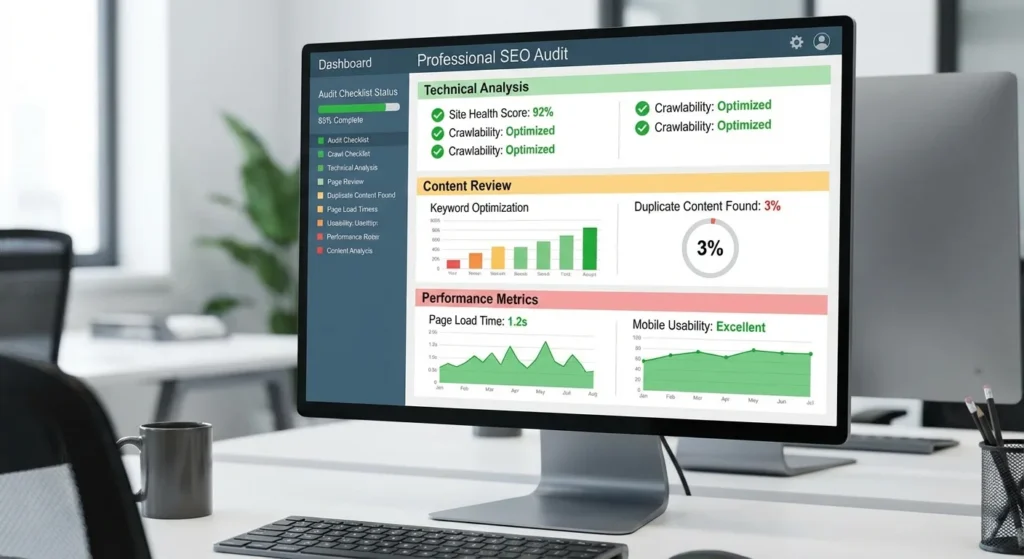
How to Conduct an SEO Audit for Improved Website Performance in 2026

Your website’s performance directly impacts your bottom line. Drop in rankings? Lost traffic? Revenue declining? These symptoms point to underlying issues that only a thorough SEO audit can uncover.
An SEO audit reveals exactly what’s holding your website back. From technical roadblocks to content gaps, algorithm penalties to security vulnerabilities – we’ll show you how to identify and fix the problems that matter most to your business results.

Why Your Website Needs Regular SEO Audits
Search algorithms change constantly. Google releases thousands of updates each year, and what worked six months ago might be hurting your rankings today. Common SEO mistakes compound over time, creating a drag on your website’s performance that gets worse without intervention.
Here’s what a professional SEO audit uncovers:
- Pages that aren’t optimised for search engines
- Algorithm penalties affecting your rankings
- Toxic backlinks damaging your domain authority
- Security vulnerabilities putting your site at risk
- Missed conversion opportunities costing you sales
We recommend conducting full SEO audits twice yearly, with quarterly check-ins on key SEO performance indicators. This schedule catches problems before they seriously impact your business.
Content Audit: Evaluating Your Website’s Foundation
Content drives both rankings and conversions. Poor content doesn’t just fail to attract visitors – it actively hurts your search performance. Google’s algorithms, particularly updates like Penguin and Helpful Content, specifically target low-quality content that doesn’t serve users.

Content Quality Assessment
Start by cataloguing every page on your website. Ask these questions for each piece of content:
- Does this solve a real problem? Content must provide genuine value to your target audience
- Is the information current and accurate? Outdated content damages credibility and rankings
- Does it match search intent? Your content should align with what people actually want when they search
- Is it better than competing pages? Google favours content that offers more value than alternatives
Low-quality pages drag down your entire site’s performance. Consider consolidating thin content, updating outdated information, or removing pages that don’t serve a purpose.
On-Page Optimisation Review
Even great content fails without proper optimisation. Review these elements for every important page:
- Title tags: Include primary keywords naturally, stay under 60 characters
- Meta descriptions: Write compelling summaries that encourage clicks
- Header structure: Use H1, H2, H3 tags to organise content logically
- Internal linking: Connect related pages to distribute authority and improve navigation
- Image optimisation: Include descriptive alt text and compress file sizes
For detailed guidance on content optimisation, see our guide on optimising blog posts for SEO.
Conversion Optimisation Analysis
Traffic means nothing without conversions. Audit your content for conversion potential:
- Clear calls-to-action on every page
- Lead magnets that capture contact information
- Landing pages optimised for specific campaigns
- Trust signals like testimonials and case studies
Content that ranks well but doesn’t convert represents missed revenue opportunities.
Technical SEO Audit: The Behind-the-Scenes Performance Factors
Technical issues often cause the most dramatic performance problems. A single technical error can prevent search engines from indexing your entire website, making even perfect content invisible to potential customers.

Site Speed and Core Web Vitals
Page speed affects both rankings and user experience. Slow sites lose visitors and revenue. Google’s Core Web Vitals measure loading performance, interactivity, and visual stability.
Use tools like Google PageSpeed Insights and GTmetrix to identify speed issues:
- Optimise images and enable compression
- Minimise HTTP requests
- Enable browser caching
- Choose fast, reliable hosting
- Optimise your content management system
Our analysis shows that improving site speed by just one second can increase conversions by 7%. For businesses, this translates directly to revenue growth.
Mobile Responsiveness and User Experience
Mobile traffic now accounts for over 60% of web searches. Google uses mobile-first indexing, meaning it primarily uses the mobile version of your content for indexing and ranking.
Test your site across different devices and screen sizes. Key areas to examine include:
- Responsive design that adapts to any screen size
- Touch-friendly navigation and buttons
- Readable text without zooming
- Fast loading on mobile networks
Poor mobile experience directly impacts your search rankings and user satisfaction. Learn more about web usability principles that improve mobile performance.
Technical Infrastructure Analysis
Search engines need to crawl and index your content efficiently. Technical problems create barriers that prevent your content from appearing in search results.
Essential technical elements to audit:
- XML sitemap: Helps search engines discover all your pages
- Robots.txt file: Controls which pages search engines can access
- SSL certificate: Encrypts data and builds trust with visitors
- Broken links: Internal and external links that return 404 errors
- Duplicate content: Multiple pages with identical or very similar content
- URL structure: Clean, descriptive URLs that include relevant keywords
For businesses new to technical SEO, our beginner’s guide to technical SEO provides step-by-step instructions for addressing common issues.

Link Profile and Authority Assessment
Your backlink profile significantly influences your domain authority and search rankings. Quality links from authoritative websites boost your credibility, while toxic links can trigger penalties that devastate your organic visibility.
Backlink Quality Analysis
Not all backlinks help your SEO. Some actively hurt your rankings. During a link audit, we examine:
- Domain authority of linking sites
- Relevance of linking pages to your content
- Anchor text distribution and naturalness
- Link velocity and acquisition patterns
- Potential spam or low-quality link sources
Tools like Ahrefs, SEMrush, and Google Search Console provide link data. Focus on earning high-quality links through proven link building strategies rather than quantity.
Internal Link Structure
Internal linking distributes page authority throughout your website and helps search engines understand your content hierarchy. Audit your internal linking strategy to:
- Ensure important pages receive sufficient internal links
- Use descriptive, keyword-rich anchor text
- Create logical content clusters around topic areas
- Fix broken internal links that harm user experience
Strategic internal linking can significantly boost your domain authority and help related content rank higher in search results.
Competitor Analysis and Opportunity Identification
Understanding your competitive landscape reveals gaps in your current strategy and opportunities for growth. Competitor analysis shows what’s working in your industry and where you can gain advantages.
Keyword Gap Analysis
Identify keywords your competitors rank for that you don’t. This reveals content opportunities and market gaps you can exploit. Look for:
- High-value keywords with significant search volume
- Long-tail opportunities with lower competition
- Local search terms relevant to your business
- Topic clusters your competitors dominate

Content and Strategy Benchmarking
Analyse what types of content perform best for your competitors. Examine their:
- Most successful content formats and topics
- Social media engagement and sharing patterns
- Link acquisition strategies and sources
- Technical implementation and site structure
Use these insights to improve your own digital marketing strategy and create content that outperforms the competition.
Creating Your SEO Action Plan
An audit without action is just expensive research. The real value comes from implementing fixes in the right order to maximise impact on your business results.
Prioritising Fixes by Impact and Effort
Not all SEO issues are created equal. Some fixes take minutes and deliver immediate results. Others require significant investment but provide long-term benefits. We recommend this prioritisation framework:
- High impact, low effort: Technical fixes, basic optimisation
- High impact, high effort: Content creation, major technical improvements
- Low impact, low effort: Minor optimisations, cleanup tasks
- Low impact, high effort: Usually not worth pursuing
Focus on quick wins first to build momentum, then tackle larger projects that drive long-term growth.
Setting Measurable Goals and Tracking Progress
Establish clear metrics before implementing changes. Track the right digital marketing metrics to measure your audit’s success:
- Organic traffic growth
- Keyword ranking improvements
- Page load speed reductions
- Conversion rate increases
- Domain authority improvements
Set realistic timelines for seeing results. Technical fixes often show immediate improvements, while content and link building efforts take 3-6 months to fully impact rankings.
When to Hire Professional SEO Audit Services
While basic audits can be done in-house, thorough analysis requires specialised tools and expertise. Consider professional services when:
- Your traffic has declined significantly
- You suspect a Google penalty
- Technical issues exceed your team’s capabilities
- You need objective analysis of your current strategy
- ROI from SEO improvements justifies the investment
Professional audits typically cost between $2,000-$10,000 depending on website size and complexity. However, the revenue impact from fixing major issues often exceeds this investment within months.
At PWD Digital Agency, we’ve conducted hundreds of SEO audits across diverse industries. Our systematic approach identifies the highest-impact opportunities specific to your business goals.

Ready to uncover what’s limiting your website’s performance? Contact our team for a professional SEO audit that delivers actionable insights and measurable results.
Frequently Asked Questions
How often should I conduct an SEO audit?
We recommend full SEO audits twice yearly, with quarterly check-ins on key metrics. More frequent audits may be needed if you experience sudden traffic drops or after major website changes.
What’s the difference between a content audit and technical audit?
A content audit evaluates the quality and optimisation of your website’s text, images, and user-facing elements. A technical audit examines behind-the-scenes factors like site speed, mobile responsiveness, and crawlability.
How long does it take to see results from SEO audit fixes?
Technical fixes often show immediate improvements in site speed and crawlability. Content and link building changes typically take 3-6 months to fully impact search rankings.
Can I conduct an SEO audit myself or do I need professional help?
Basic audits can be done in-house using free tools like Google Search Console. However, thorough analysis of technical issues, penalties, and competitive opportunities typically requires professional expertise and premium tools.
What tools are needed for a complete SEO audit?
Essential tools include Google Search Console, Google Analytics, and page speed testing tools. Professional audits also use premium tools like Ahrefs, SEMrush, or Screaming Frog for deeper analysis of links, keywords, and technical issues.
How much does a professional SEO audit cost?
Professional SEO audits typically range from $2,000-$10,000 depending on website size and complexity. The investment often pays for itself within months through improved traffic and conversions.