
Google Search Penalties: From Speed Bumps to Death Row

Watch our video summary of this topic below, or read on for the full breakdown.
Watch: The End of the SEO Speed Bump
Picture this: You pour your morning coffee, open your analytics dashboard expecting the usual steady stream of organic traffic, and instead find a flat line. Not a dip – a complete zero. Your organic traffic didn’t gradually decline; it vanished overnight like someone flipped a switch.
For over a decade, getting caught pushing SEO boundaries was manageable. You’d cop a penalty, fix the issues, submit a reconsideration request, and get back to business. Google penalties were speed bumps – annoying but temporary friction points on the road to rankings.
That era is over.
Recent industry data reveals a chilling shift: Google is increasingly making domain blacklisting permanent. Even when website owners clean up every technical violation, present squeaky-clean sites, and follow every guideline to the letter, reconsideration requests are being flatly rejected.
The stakes have escalated from temporary traffic loss to complete digital execution. When the top organic search result captures 27-28% of all clicks, permanent blacklisting isn’t just a setback – it’s an existential threat to your business.
The Death of the Speed Bump Era

Google penalties used to operate like traffic violations. Push too hard with questionable backlinks or publish thin content to cast a wide net? You’d get pulled over, receive a citation, pay the fine, and keep driving. The unwritten rule was forgiveness through compliance.
Today’s reality is different. Google has shifted from issuing temporary fines to imposing permanent consequences. The speed camera doesn’t just catch you speeding – it revokes your licence forever.
This philosophical change stems from necessity. The explosion of AI-generated content has flooded search results with synthetic, low-value pages. Google can’t afford to play whack-a-mole with individual spam articles anymore. Instead, they’re targeting the source: domains that fundamentally operate through manipulative practices.
Understanding Google’s Enforcement Mechanisms
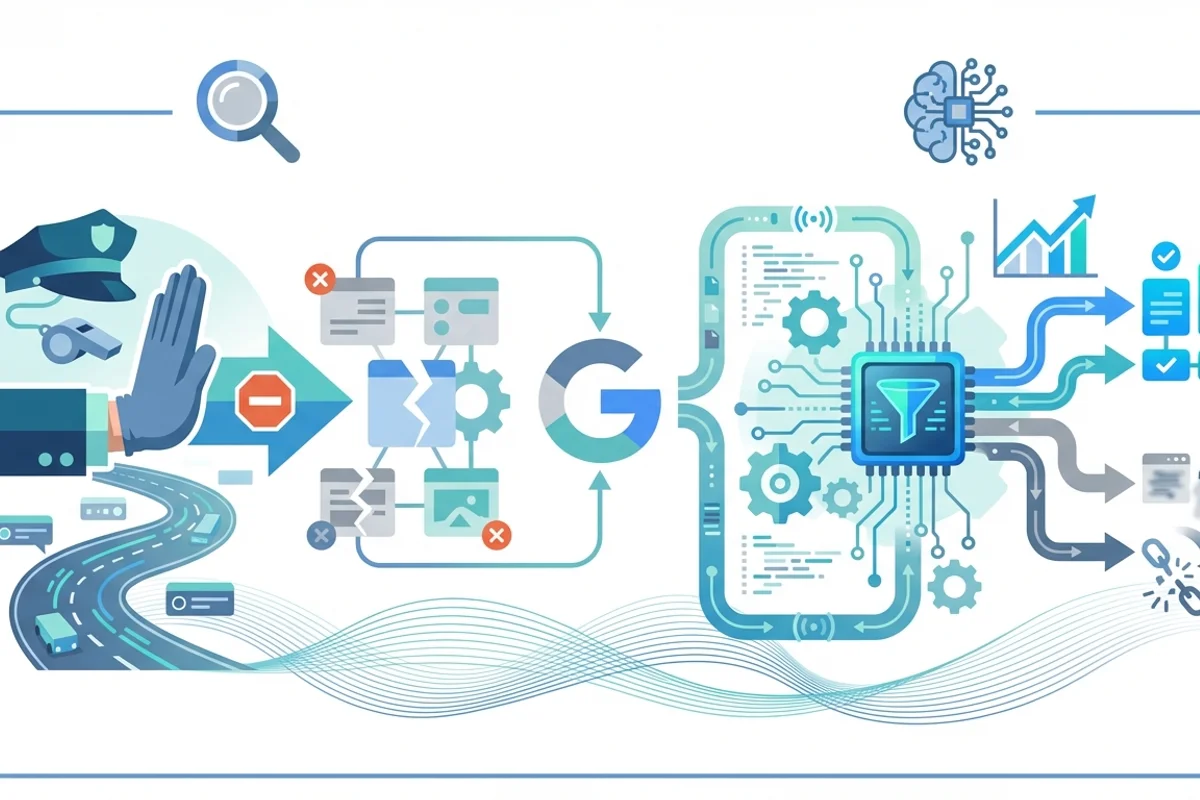
Google applies penalties through two distinct mechanisms, each requiring different diagnostic and recovery approaches.
Manual Actions: The Traffic Cop
Manual actions are applied by human reviewers at Google who identify severe violations of search guidelines. Think of this as getting pulled over by a traffic cop – there’s direct human intervention, clear communication about what went wrong, and a defined process for resolution.
Key characteristics of manual actions:
- Affect less than 1% of indexed websites
- Reserved for egregious violations like pure spam or malware distribution
- Generate email notifications and flags in Google Search Console
- Require reconsideration requests after fixes are implemented
To check for manual actions, log into Google Search Console, navigate to “Security & Manual Actions,” and click “Manual Actions.” If your site is clean, you’ll see “No issues detected.” Penalised sites will show specific violations and their scope.

Algorithmic Demotions: The Hidden Speed Camera
Algorithmic demotions happen automatically when Google’s AI systems determine your content quality, link patterns, or user experience don’t meet standards. These operate like hidden speed cameras – no flash, no immediate feedback, and no warning until you discover the damage weeks later.
Unlike manual actions, algorithmic penalties:
- Don’t trigger Search Console warnings
- Provide no email notifications
- Require correlation analysis to identify
- Need long-term site improvements for recovery
Google’s current algorithmic systems include:
- Panda: Targets thin, duplicate, or low-quality content
- Penguin: Identifies spammy link profiles and manipulative backlinks
- SpamBrain: AI system detecting link spam and mapping unnatural link networks
- Helpful Content System: Rewards human-focused content over search engine optimisation
SpamBrain represents the most sophisticated enforcement tool. Rather than evaluating individual links in isolation, it maps relationships between thousands of websites, identifies unnatural clusters, and neutralises entire networks simultaneously.
The Invisible Threat: Diagnosing Algorithmic Hits

When there’s no dashboard warning light, you must become a data detective. Algorithmic demotions are silent killers that require systematic investigation to uncover.
Start with your analytics platform. Isolate organic traffic and look for sudden, steep drops – not gradual declines, but cliff-like falls that occur within days. Once you identify the exact date, cross-reference it with known Google algorithm updates. If your visibility collapsed the same week Google rolled out a major SpamBrain update, correlation provides your diagnosis.
Use third-party rank tracking tools like SEMrush or Ahrefs to confirm keyword position losses across your entire domain. Sometimes analytics drops result from broken tracking codes rather than actual penalties.
Before assuming you’ve been algorithmically penalised, rule out self-inflicted wounds. Check that your developer didn’t accidentally block the site with robots.txt or leave noindex tags on core pages. Always check the plumbing before assuming the city shut off your water supply.
The Expanding Minefield: Google News and Discover Penalties
Between 2024 and 2025, Google introduced twelve new manual penalties specifically targeting content marketing violations in Google News and Discover. These represent a massive expansion of enforcement scope, catching businesses that depend on these traffic sources off guard.
The twelve specific violations include:
- Adult-themed content outside scientific/educational contexts
- Dangerous content promoting harm or illegal activity
- Harassing content involving bullying or doxxing
- Hateful content inciting violence based on personal characteristics
- Medical misinformation spreading false health information
- Violence and gore showing graphic content
- Terrorist content supporting or promoting terrorism
- Manipulated media using deepfakes without clear labelling
- Deceptive practices including clickbait and fake news
- Impersonation pretending to be other organisations
- Spammy or repetitive mass-produced content
- Transparency violations missing author bylines or publication dates
The transparency and spam rules pose particular traps for businesses scaling content through AI. If you generate hundreds of blog posts without proper author attribution, primary source citations, or human oversight, you risk triggering multiple violations simultaneously.

Here’s the dangerous scenario: Your marketing budget gets slashed, so you use AI to generate supplementary blog content. The AI produces repetitive articles without real author bios or source citations. You publish without malicious intent, just trying to compete. Suddenly, you’ve triggered both spammy content and transparency violations.
Google is essentially forcing every publisher to operate with newsroom-level editorial standards. If you want the privileged traffic from News and Discover, you must adhere to journalistic principles.
The New Recovery Reality
Recovery from News and Discover penalties requires more than content deletion. Google now demands concrete evidence of structural business changes, including:
- Staff training logs proving educational initiatives
- New editorial guidelines showing human oversight processes
- Documentation of editorial board establishment
- Proof of ongoing quality control measures
You’re no longer just fixing code – you’re proving your corporate structure deserves trust. Google wants to see your HR handbook before letting you back in.
Domain Blacklisting: The Digital Death Penalty
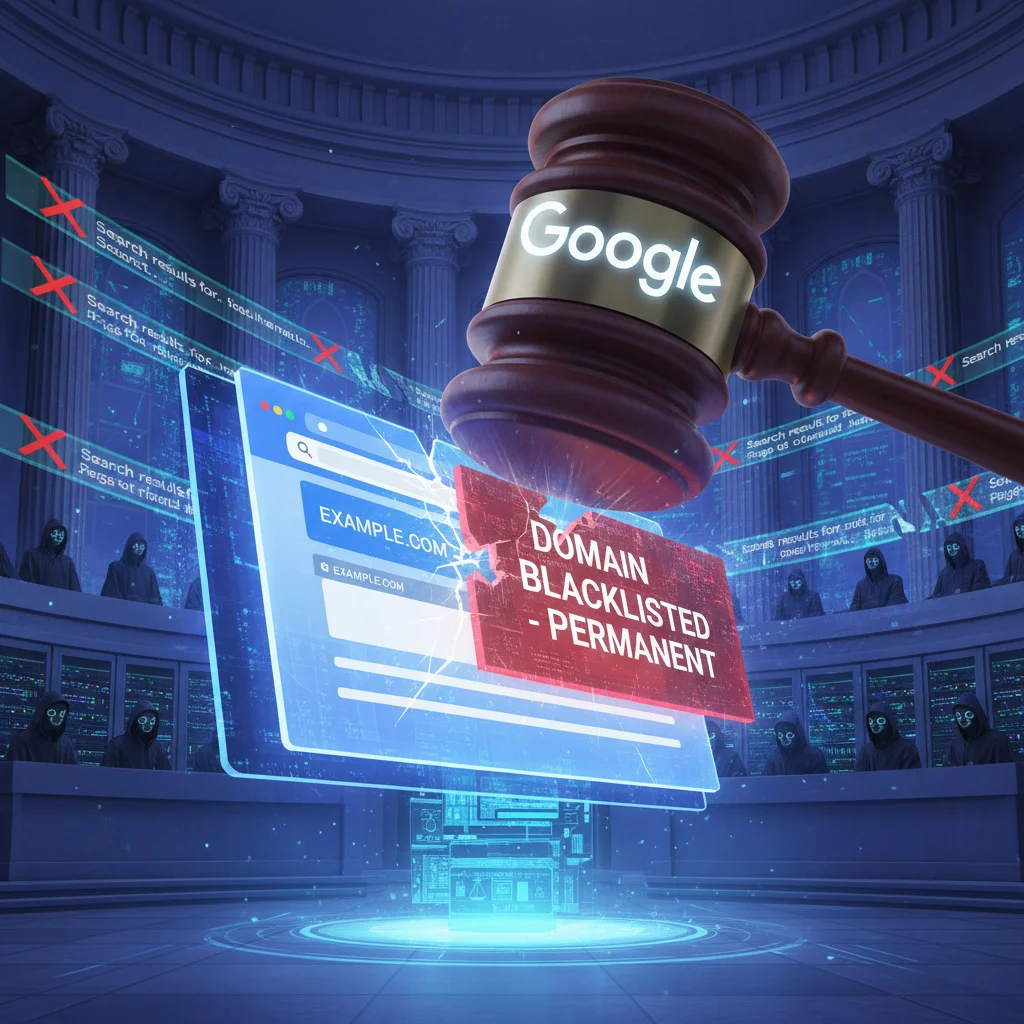
The most severe penalty level is complete domain blacklisting – what Google calls “delisting” or “complete deindexing.” This isn’t a ranking demotion from page one to page four; it’s total removal from Google’s index.
Signs of complete blacklisting include:
- Zero organic traffic in analytics (absolute flat line)
- Complete disappearance from rank tracking tools
- Site: searches returning no results
- Manual action in Search Console for “Pure Spam” or similar severe violations
Traditional recovery involved cleaning up violations and submitting reconsideration requests. The shocking development is that Google now frequently rejects these requests even when every technical issue has been resolved.
Industry researchers tracking thousands of penalty recovery attempts report a chilling trend: Google is making domain blacklisting permanent, regardless of cleanup efforts.
Why Google Stopped Forgiving
The shift from temporary speed bumps to permanent consequences represents a fundamental philosophical change within Google’s web spam team. Previously, manual actions operated like technical checklists – remove the bad links, delete hidden text, pass the test, get your traffic back.
Today, Google evaluates the fundamental perception and trustworthiness of domains themselves. If they determine a site was built on manipulative practices as its core growth strategy – if deception was baked into its DNA from inception – they decide the domain can never be trusted again.
This creates necessary deterrent effects. If bad actors know they can spam the web, make quick profits, get caught, spend a month cleaning up, and immediately regain rankings, there’s no real consequence. By making domain execution permanent, Google sends a market message: manipulate our systems at scale, and you lose your digital real estate forever.
Survival Strategies for the New Reality
With stakes escalated from temporary traffic dips to permanent domain death, businesses must abandon any strategy resembling shortcuts. SEO success now requires complete commitment to white-hat practices built around Google’s E-E-A-T framework: Experience, Expertise, Authoritativeness, and Trustworthiness.
The Critical “E” – Experience
The recently added “Experience” component demands proof of real-world interaction. Product reviews need original photos showing hands-on testing. Content must discuss actual flaws discovered during use. AI couldn’t possibly hallucinate these authentic details.
The era of profitable websites built entirely from shallow affiliate pages that summarise Amazon reviews is over. These sites are prime targets for algorithmic demotion.
Content Excellence Standards
Modern content marketing requires:
- Heavy human oversight by genuine subject matter experts
- Unique value that AI cannot replicate
- Primary source citations and proper attribution
- Clear author bylines with real credentials
- Regular content audits and quality pruning
Be ruthless about quality control. Legacy blog posts from years ago that generate zero traffic and provide zero value should be either substantially updated or permanently deleted. Thin content drags down the trust evaluation of your entire domain.
Technical Foundation Protection
Your technical SEO foundation must be immaculate:
- Conduct regular proactive link audits
- Monitor who links to you using tools like Search Console, SEMrush, or Ahrefs
- Use Google’s Disavow Tool proactively when toxic networks attach to your domain
- Lock down security to prevent malware injection
- Moderate user-generated content to prevent pharmaceutical spam
You cannot set your backlink profile and forget it. Link building now requires ongoing vigilance and maintenance.
Authority Through Genuine Digital PR
Earn authority through legitimate digital PR rather than manipulative link building strategies. Get quoted in real publications because you have valuable insights to share. Build relationships with journalists in your industry. Create content worthy of natural editorial links.
The focus shifts from reverse-engineering algorithms to building brands that fundamentally deserve top rankings.

Monitoring and Measurement
Proactive monitoring prevents surprise penalties. Implement systematic tracking across key SEO KPIs:
- Daily organic traffic monitoring through Google Analytics
- Weekly rank tracking for core keywords
- Monthly link profile audits
- Quarterly content quality assessments
- Regular Search Console manual action checks
Set up alerts for dramatic traffic drops so you can investigate immediately rather than discovering problems weeks later.
The Alternative: Paid Traffic Insurance
While organic search remains the most cost-effective long-term traffic source, smart businesses diversify their digital marketing mix. Google Ads management provides traffic insurance that can’t be algorithmically revoked.
Paid search offers immediate traffic control and immunity from organic penalties, making it essential backup protection in an environment where organic visibility can vanish permanently overnight.
Local Business Considerations
Local businesses face additional vulnerability through Google Business Profile penalties and local pack demotions. Our thorough local SEO guide covers specific strategies for protecting local search visibility.
Local penalties often stem from fake reviews, keyword stuffing in business descriptions, or attempts to game proximity factors through false addresses.
The Future of Search Penalties
Current trends suggest Google’s enforcement will become even more sophisticated. As AI systems analyse broader brand reputation signals across the entire internet – not just what sits on your server – domain survival may depend on your overall corporate reputation.
The hidden speed camera analogy extends further: What if the system doesn’t just check how fast you’re driving right now, but uses AI to analyse every review you’ve received, every forum mention of your brand, and your entire business history to decide if you deserve a licence at all?
If domain survival depends on full-picture evaluation of your “corporate soul,” traditional SEO tactics become irrelevant compared to fundamental business integrity.
Conclusion: Building Undeniable Trust
The transition from speed bumps to permanent consequences represents the maturation of search as a medium. Google can no longer tolerate manipulative actors flooding results with synthetic content designed purely for algorithmic consumption.
Businesses that refuse to adapt from optimisation to reputation building will discover their next speed bump is actually a brick wall. When your entire search visibility can be revoked without a second chance, building undeniable trust becomes the only strategy that matters.
The era of shortcuts is over. The era of earning your rankings has begun.
Google Search Penalties & Manual Actions Reference
Every major Google penalty and algorithmic action – what triggers it, how to spot it, and how to recover.
Pages with little or no original content, or shallow affiliate pages that provide no unique value to the user.
Copying content from other sites without adding value, or publishing mass-produced AI content without human oversight or originality.
Overloading a page with keywords or hiding text from users (e.g., white text on white background) to manipulate rankings.
Algorithmic system targeting low-quality, thin, or duplicate content.
Rewards content created specifically for humans rather than search engines.
Acquiring backlinks through manipulative schemes, paid links, or link exchanges; sudden spikes in low-quality backlinks.
Selling links that pass PageRank or linking excessively to low-quality, unrelated sites.
Algorithmic system targeting spammy link profiles and low-quality backlinks.
AI system that continuously detects link spam and manipulative practices.
Severe violations of Google’s spam policies, often leading to blacklisting or complete deindexing.
Showing different content to search engines than to users, or redirecting visitors to unexpected/malicious pages.
Pages compromised and injected with malicious code, spam, or phishing links.
Publishing nudity or sexually explicit material outside of scientific or educational contexts.
Inciting violence or hatred based on characteristics like race, religion, or gender.
Publishing false or misleading health information.
Failing to provide author bylines, publication dates, or contact information.
Listen to the Full Podcast
Prefer to listen? Here’s the full deep-dive podcast covering everything in this article and more.
Frequently Asked Questions
How can I tell if my site has been hit by an algorithmic penalty versus a manual action?
Manual actions appear in Google Search Console under “Security & Manual Actions” with specific violation details and email notifications. Algorithmic penalties show no warnings – you must correlate sudden traffic drops in Analytics with known Google algorithm update dates. Use rank tracking tools to confirm if keyword positions dropped across your entire domain.
Is it still possible to recover from a Google penalty in 2024-2025?
Recovery depends on the penalty type. Algorithmic demotions can recover through long-term content and link quality improvements. However, manual action recovery has become increasingly difficult, with Google frequently rejecting reconsideration requests even after complete technical cleanup. The focus has shifted from fixing violations to proving overall domain trustworthiness.
What are the biggest risks when using AI-generated content?
AI content risks triggering transparency violations (missing author bylines, publication dates), spammy content penalties (repetitive, mass-produced posts), and manipulated media violations (AI-edited images without labels). The safest approach is using AI as a research tool while maintaining heavy human oversight, expert review, and original insights that AI cannot replicate.
How do I protect my site from toxic backlinks that could trigger penalties?
Conduct monthly link audits using Google Search Console, SEMrush, or Ahrefs to monitor your backlink profile. When you identify toxic links from spam networks or low-quality directories, first attempt outreach for removal. For links that cannot be removed, compile them into Google’s Disavow Tool to signal that these links should be ignored. Proactive monitoring prevents penalties better than reactive cleanup.
Should I still focus on organic SEO if penalties are becoming permanent?
Yes, but with a fundamental mindset shift. Focus on building genuine authority through white-hat practices, quality content, and legitimate digital PR rather than trying to manipulate rankings. Consider organic SEO as long-term brand building while diversifying with paid traffic sources like Google Ads for immediate traffic insurance. The businesses succeeding long-term are those treating SEO as reputation building rather than algorithm gaming.