Google's November 2026 core update: what's changing, when it ends, and how Australian businesses should read the data

Google started rolling out its November 2026 core update at 10:06 am US Pacific time on 10 November, which was 2:06 am on Wednesday 11 November in Perth. Google says the update applies globally and to all languages, and that the rollout may take up to two weeks.
If your rankings or traffic have moved over the past week, this is probably part of the reason. The most important advice right now is also the least exciting: don’t change anything yet. Below we cover what Google has said, when the update should finish, why this one has awkward timing for online retailers, and how to read your data once the dust settles.
The short version
- It’s a broad core update, not a penalty. Google calls it “a regular update designed to better surface relevant, satisfying content for searchers from all types of sites.”
- It’s the third core update of 2026, after March and May. Search Engine Journal counts it as the eighth ranking update on Google’s Search Status Dashboard this year.
- Expect it to finish around 25 November, Perth time. That is two days before Black Friday.
- Google says to wait. Assess your site at least a full week after the rollout finishes, comparing against a week before it started.
- Retailers need a different comparison. The week after the update will include Black Friday and Cyber Monday, so comparing it with a normal week in early November will mislead you.
What Google has said
Google announced the update on its Search Status Dashboard and on the Search Central LinkedIn page. The dashboard entry is one sentence long.
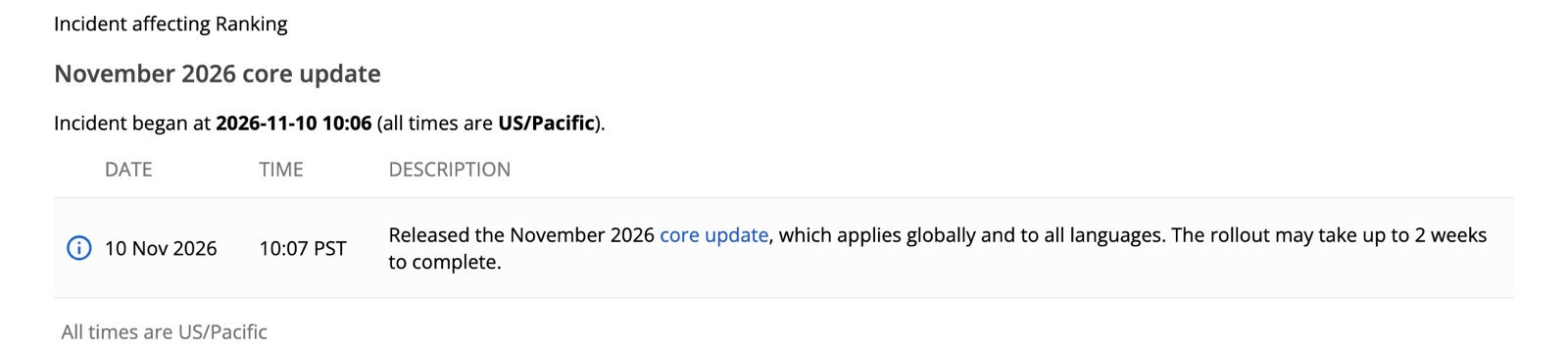
The November 2026 core update on Google’s Search Status Dashboard. Image: Google.
The LinkedIn post adds that this is a “regular update designed to better surface relevant, satisfying content for searchers from all types of sites”. As Search Engine Journal pointed out, that is the same wording Google used for the March 2026 core update. Google hasn’t published a blog post, named any specific goals for the update, or changed its core updates documentation, which was last revised in December 2025.
In other words, there is no new rule to comply with. Core updates are broad changes to how Google’s systems assess content as a whole. Google’s own explanation compares it to updating a list of your favourite restaurants: new places open, others improve, and a restaurant that drops down your list isn’t necessarily bad. Other pages have simply become better answers.
How long will it take?
Google says up to two weeks. Recent core updates have stayed close to that:
| Core update | Started (US time) | Finished | Length |
|---|---|---|---|
| March 2026 | 27 March | 8 April | About 12 days |
| May 2026 | 21 May | 2 June | About 12 days |
| November 2026 | 10 November | Expected around 24 November | Up to 14 days |
Search Engine Roundtable’s tally of 23 confirmed core updates since 2019 puts the median rollout at 14 days. Some have run longer, most notably March 2024 at 45 days, so treat 24 November as an estimate until Google posts a completion note on the dashboard.
Why the timing matters for Australian retailers
A full two-week rollout would end around 24 November in the US, which is 25 November here. Black Friday falls on 27 November and Cyber Monday on 30 November.
Black Friday is now one of the biggest online trading periods of the year in Australia too. That creates two problems for ecommerce businesses:
- Rankings may still be settling as the sales start. Expect some movement in the days around the finish line. Don’t panic over a single day’s data.
- The usual before-and-after comparison breaks. Google recommends comparing a full week after the update with a week before it started. For a retailer, the week after includes Black Friday and Cyber Monday. Comparing that with an ordinary week in early November will make your traffic look better than it is, and could hide a real ranking drop.
If you sell online, compare average position for your key product and category queries rather than clicks, which are inflated by sale demand. Where you have the history, also compare year on year against the same sale week in 2025.
What early tracking is showing
Volatility trackers picked up noticeable movement from Saturday 14 November, and Search Engine Roundtable’s roundup of forum chatter on 16 November describes a mixed picture. Some site owners report gains, some report drops of 20% or more, and some say their results change on every refresh. One analyst also flagged two sites that had scaled up with AI-generated content dropping sharply.
None of that tells you much about your own site yet. Rankings during a rollout are noisy, and forum reports skew towards people who saw big swings. Wait for the update to finish before you draw conclusions.
How to check your site after the update
This is the process we’ll use for our own SEO clients, based on Google’s core update guidance.
- Confirm the update has finished. Check the Search Status Dashboard for the completion note.
- Wait a full week after it finishes. If it ends on 24 November, that takes you to early December.
- Compare the right weeks in Search Console. In the Performance report, compare a full week after the update with the week before it started (3 to 9 November). Retailers should also run the year-on-year comparison described above.
- Look at your top pages and queries, not just the total. A site-wide total can hide one important page that fell a long way.
- Separate small moves from big ones. Google’s own examples are useful here. A drop from position 2 to 4 is a small move, and Google advises against making drastic changes to content that’s already performing well. A drop from position 4 to 29 needs a deeper look.
- Check each search type separately. Web, Image, Video and News results can move differently.
If you’ve seen a large, sustained drop, work through Google’s helpful content self-assessment for the pages that fell furthest, and be honest about the answers. Compare them with the pages that now outrank you. Ask whether those pages answer the searcher’s question better, show more first-hand experience, or are simply more up to date.
What not to do
- Don’t make changes mid-rollout. You can’t tell whether a fix helped or whether the update just moved again.
- Don’t go after quick fixes. Google specifically warns against removing page elements “because you heard it was bad for SEO”. Make changes that would help your customers even if Google didn’t exist.
- Don’t mass-delete content. Google calls deletion a last resort. Improve or consolidate weak pages before removing them.
- Don’t expect an instant recovery. Google says improvements can take effect within days, but it may take several months for its systems to confirm a site has improved. Sometimes that means waiting for the next core update.
What this means beyond Google’s blue links
Core updates affect more than the classic results page. Search Engine Roundtable notes that they also influence Google Discover, featured snippets and other search features. Google has also indicated that its core ranking signals feed into AI experiences such as AI Overviews and AI Mode. Content that holds up well through a core update is usually the same content that gets cited in AI answers. We cover that side of things in our guide to getting your business seen in ChatGPT, Gemini and AI search.
If you want the longer history, our explainers on every major Google algorithm update and Google’s broad core updates since 2023 go back further.
What to do this week
- Note the dates. The update started on 11 November (Perth time) and is expected to finish around 25 November.
- Save a baseline. Export your Search Console performance data for 3 to 9 November now, while it’s easy to find.
- Annotate your analytics. Add a note in GA4 so anyone looking at the data later knows a core update was running.
- Hold off on big content or site changes until the rollout has finished.
- Retailers: set up your year-on-year comparison now, before the Black Friday traffic arrives.
If you’d like a second set of eyes on what the update has done to your site, our Perth SEO team can review your Search Console data once the rollout has finished and tell you plainly whether anything needs to change. Get in touch and we’ll take a look.
Frequently asked questions
When did the November 2026 core update start in Australia?
It started at 10:06 am US Pacific time on 10 November 2026, which was 2:06 am on 11 November in Perth and 5:06 am on 11 November in Sydney and Melbourne.
When will it finish?
Google says the rollout may take up to two weeks, which points to around 24 November US time, or 25 November in Australia. Google will post a completion note on its Search Status Dashboard when it’s done.
Is a core update a penalty?
No. Core updates don’t target specific sites or pages. They change how Google’s systems assess content overall, so some pages rise and others fall as a result. A site that drops hasn’t necessarily done anything wrong.
My rankings dropped this week. Should I change my content?
Not yet. Wait until the update has finished and then a further week, so your data reflects where things settled. Small drops, such as position 2 to 4, usually don’t need any action. Large, sustained drops deserve a careful review.
Does the core update affect AI Overviews and AI Mode?
Google has indicated that its core ranking signals feed into its AI experiences, so changes in how Google assesses your content can show up there as well as in the standard results.
How long does it take to recover from a core update?
Google says some improvements take effect within days, but it can take several months for its systems to recognise that a site has improved. In some cases recovery only shows up at the next core update.
Sources
- November 2026 core update, Google Search Status Dashboard, 10 November 2026
- Google Search’s core updates and your website, Google Search Central
- Google’s November 2026 Core Update Starts Rolling Out, Search Engine Journal, 10 November 2026
- Google November 2026 Core Update Is Rolling Out, Search Engine Roundtable, 10 November 2026
- Google November 2026 Core Update Ranking Flux - What We’re Seeing, Search Engine Roundtable, 16 November 2026