ChatGPT Business Hub: what it is, what it measures, and what Australian businesses should do now

On 10 November 2026, OpenAI launched Businesses in ChatGPT, and with it Business Hub: a dashboard where a business can claim its profile in ChatGPT, keep its details up to date and see how often ChatGPT points people to it. It is the closest thing ChatGPT has had to Google Search Console or a Google Business Profile, and with OpenAI reporting 1.2 billion weekly users, it deserves a place on every marketing checklist.
It also comes with a catch. The headline metric, “mentions”, does not mean what most marketers think it means. Below we cover what Business Hub does, what Australian businesses can use today, how to read the numbers, and what it still won’t tell you.
The short version
- Business Hub is in beta and costs nothing to claim. OpenAI hasn’t ruled out charging later, according to its comments to Digiday.
- You get three things: a profile you can edit, a small insights dashboard, and (for some US businesses only) a Business Agent that chats with customers on your behalf.
- A “mention” is closer to a citation. For an online business it only counts when ChatGPT references your website. Your brand name on its own does not count.
- Claiming does not lift your visibility. OpenAI says plainly that claiming a profile doesn’t change how often ChatGPT recommends you.
- Australian availability is uneven. Online businesses can claim or add a profile now. Physical stores and restaurants can currently only claim existing US listings, and Business Agents are US-only.
What is ChatGPT Business Hub?
Business Hub is the management side of Businesses in ChatGPT. You open it from the ChatGPT sidebar, find your business and prove you are allowed to manage it. Once you are verified, you can:
- Manage your profile. Update your website, description, category, logo, cover photo, and delivery and return policies. Retailers can connect a product feed with prices and stock levels.
- View insights. See mentions, profile views, website clicks and your top five “discovery topics” over 7 or 28 days.
- Publish a Business Agent. A branded assistant that answers questions about your products and policies inside ChatGPT, in a clearly labelled chat that is separate from ChatGPT’s own answers. For now this is limited to eligible ecommerce and online service businesses in the United States.
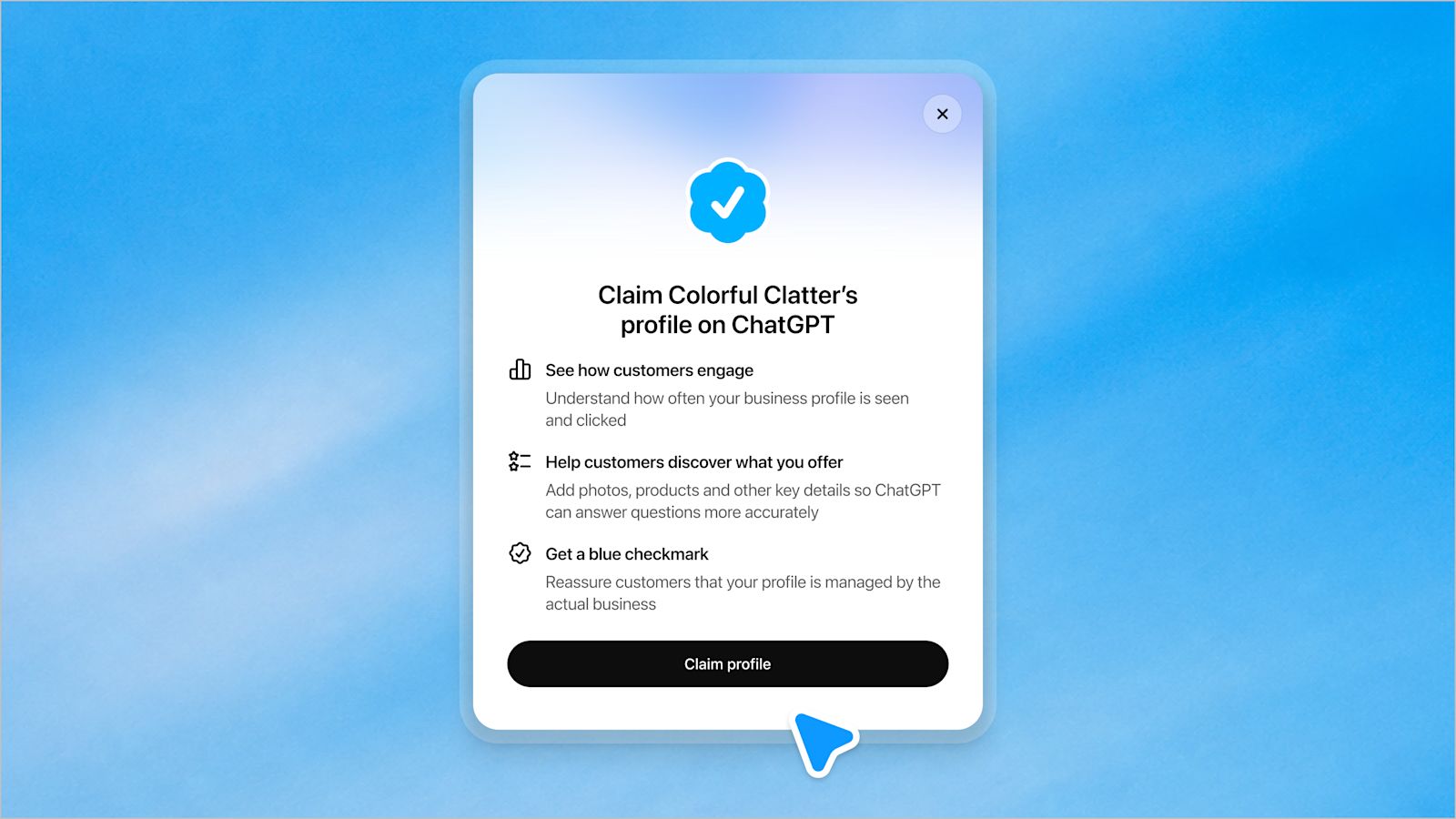
An example business profile before it is claimed. Image: OpenAI.
Don’t confuse it with ChatGPT Business, the paid team plan. They are unrelated.
Can Australian businesses use it yet?
Partly. OpenAI’s help centre says any eligible business can claim a profile where ChatGPT is available and where verification is supported, but the detail matters:
| Business type | What you can do in Australia today |
|---|---|
| Online business (ecommerce, online services, B2B) | Claim an existing profile, or add one if none exists |
| Local store, restaurant or service location | Not yet: physical locations can currently only claim existing US listings |
| Business Agent | Not yet: US ecommerce and online service businesses only |
| Shopify store | Connect your store to speed up verification. Eligible Shopify products already appear in ChatGPT through Shopify Catalog |
So a Perth online retailer or software company can set up a profile this week. A Perth café, clinic or tradie business that relies on its physical location will have to wait. In the meantime, your Google Business Profile and the reviews and directories around it still shape what AI tools say about local businesses.
How to claim and verify your profile
- Find your business. Sign in to ChatGPT, open Business Hub from the sidebar and search for your business name.
- Verify your claim. Choose one of the methods offered: a code sent to your business phone or business email, a TXT record added to your domain’s DNS, or a Shopify login. If someone else manages your domain, they will need to add the DNS record for you.
- Wait for approval. OpenAI reviews the claim and emails you a decision.
- Complete identity verification with Persona. This is required before you can edit details, see insights or build an agent. Have your government-issued ID, your ABN or company registration details, and proof you are authorised to act for the business ready. Your profile only gets the blue verified tick once this step is approved.
- Fill in the profile properly. Write a short, specific description of what you do, who you serve and where. Add your logo, cover photo and policies. Treat it the way you treat your Google Business Profile: a half-finished profile is a missed opportunity.
- Give your agency access if you use one. The admin who claimed the business can add teammates and grant an agency access, with each person using their own ChatGPT account. Don’t forward your claim invitation to someone else.
One practical tip: make sure the business name, address and registration number you give match your official records exactly. OpenAI’s help centre points to mismatched details as the first thing to fix if a verification check fails.
What does a “mention” actually mean?
This is the most important part of the launch to get right, because these numbers will end up in reports.
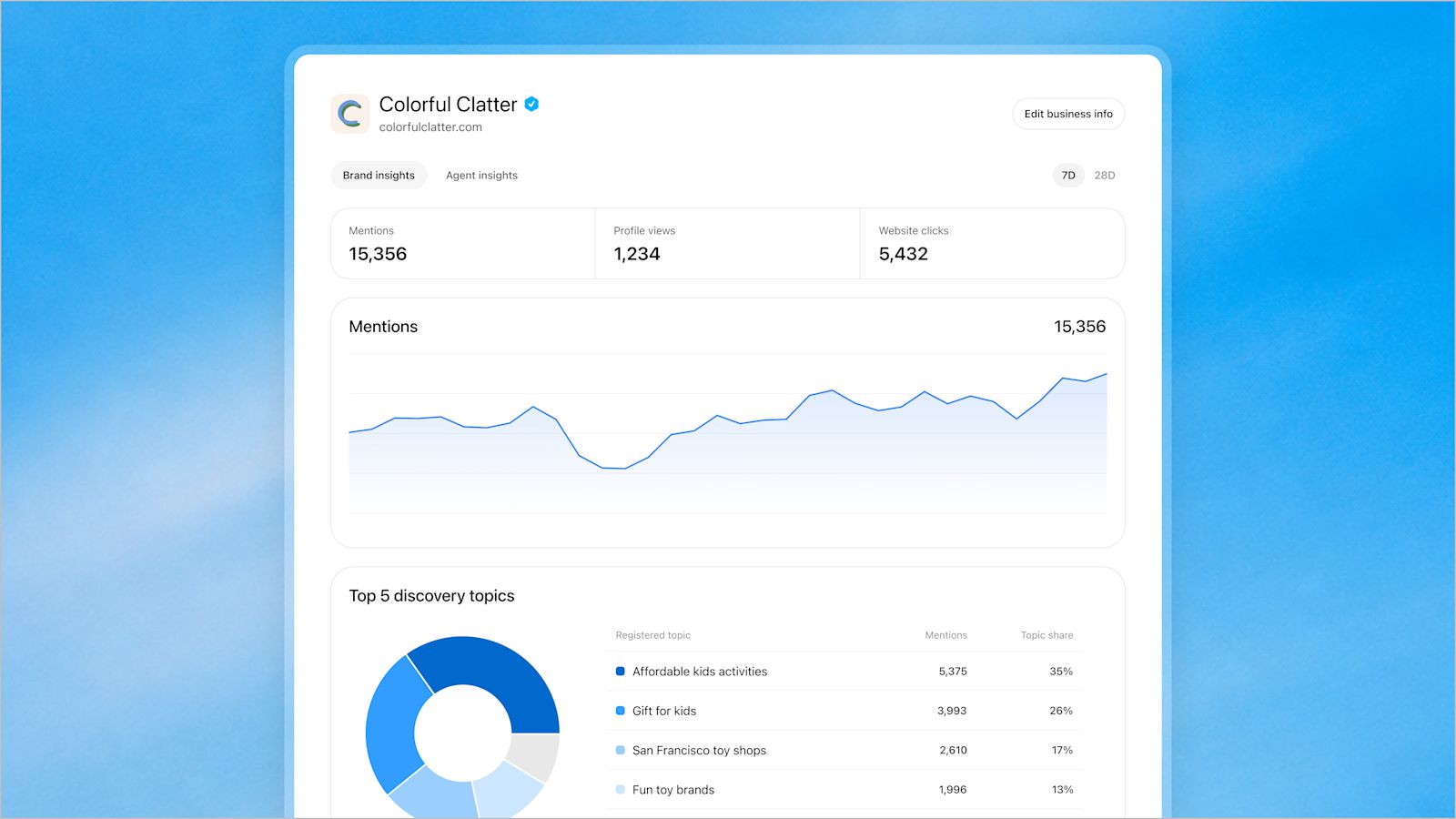
Business Hub’s insights view, shown with OpenAI’s sample data. Image: OpenAI.
OpenAI’s help centre defines a mention differently depending on the business:
| Business type | Counts as a mention | Doesn’t count |
|---|---|---|
| Online business | ChatGPT references your website | Your brand named in an answer without your site |
| Local business | ChatGPT shows a result for your location, even if nobody opens it | — |
In SEO and AI search circles, a “brand mention” usually means your brand is named in the answer. What Business Hub counts for online businesses is a citation: a reference to your website. If ChatGPT recommends you by name but links to a review site or directory instead of your domain, Business Hub records nothing. For many businesses that is a big share of their real visibility.
The other metrics have limits too:
- Website clicks are clicks on links in ChatGPT, not confirmed visits or sales. They won’t match Google Analytics, partly because some ChatGPT traffic arrives without referrer data and shows up as direct.
- Discovery topics are broad themes across conversations where your site was cited. They don’t show the questions people actually asked.
- Blank isn’t zero. Insights only appear once activity passes a reporting threshold, so smaller businesses may see empty fields for a while.
When you report these numbers internally, call them what they are: ChatGPT website citations and clicks, not brand mentions.
What a click-through rate looks like
The one genuinely new number Business Hub gives you is a ratio: how often ChatGPT referenced your site against how often someone clicked.
AI visibility platform OtterlyAI published its own first week of data: 55,939 mentions and 329 website clicks over seven days, a click-through rate of about 0.6%. That is roughly one click for every 170 times ChatGPT cited its site.
One business’s figures won’t predict yours, but it fits the broader picture of AI search: most of the value happens inside the answer, before anyone clicks. Being cited, named and described accurately matters more than the trickle of traffic that follows. Record your own baseline in the first week and track it over time.
What Business Hub won’t tell you
OpenAI has been clear that it won’t share users’ conversations, which is the right call for privacy. It does mean the dashboard leaves the most useful questions unanswered:
- Which prompts people asked when your site came up
- How you compare with competitors, or your share of voice in your category
- Unlinked brand mentions, where you are named but your site isn’t cited
- Sentiment: whether ChatGPT describes you accurately and favourably
- Which of your pages were cited or clicked
- Which other sites ChatGPT cites instead of you
- What to change to improve
- Any other AI platform: Google AI Overviews and AI Mode, Gemini, Perplexity and Copilot are all out of scope
Search Console didn’t replace SEO tools, it gave everyone a baseline to measure them against. Business Hub works the same way. Use it as your first-party ChatGPT baseline, and use prompt testing and AI visibility tracking to explain what is driving the numbers. Our guide to why businesses don’t show up in ChatGPT and AI search walks through a repeatable prompt test you can run yourself.
Business Agents: worth watching, even from Australia
Business Agents aren’t available here yet, but they show where this is heading. An agent answers product and policy questions inside ChatGPT, using your product feed and the instructions you write. It can’t take payments, make bookings or check orders. It links back to your website for that.
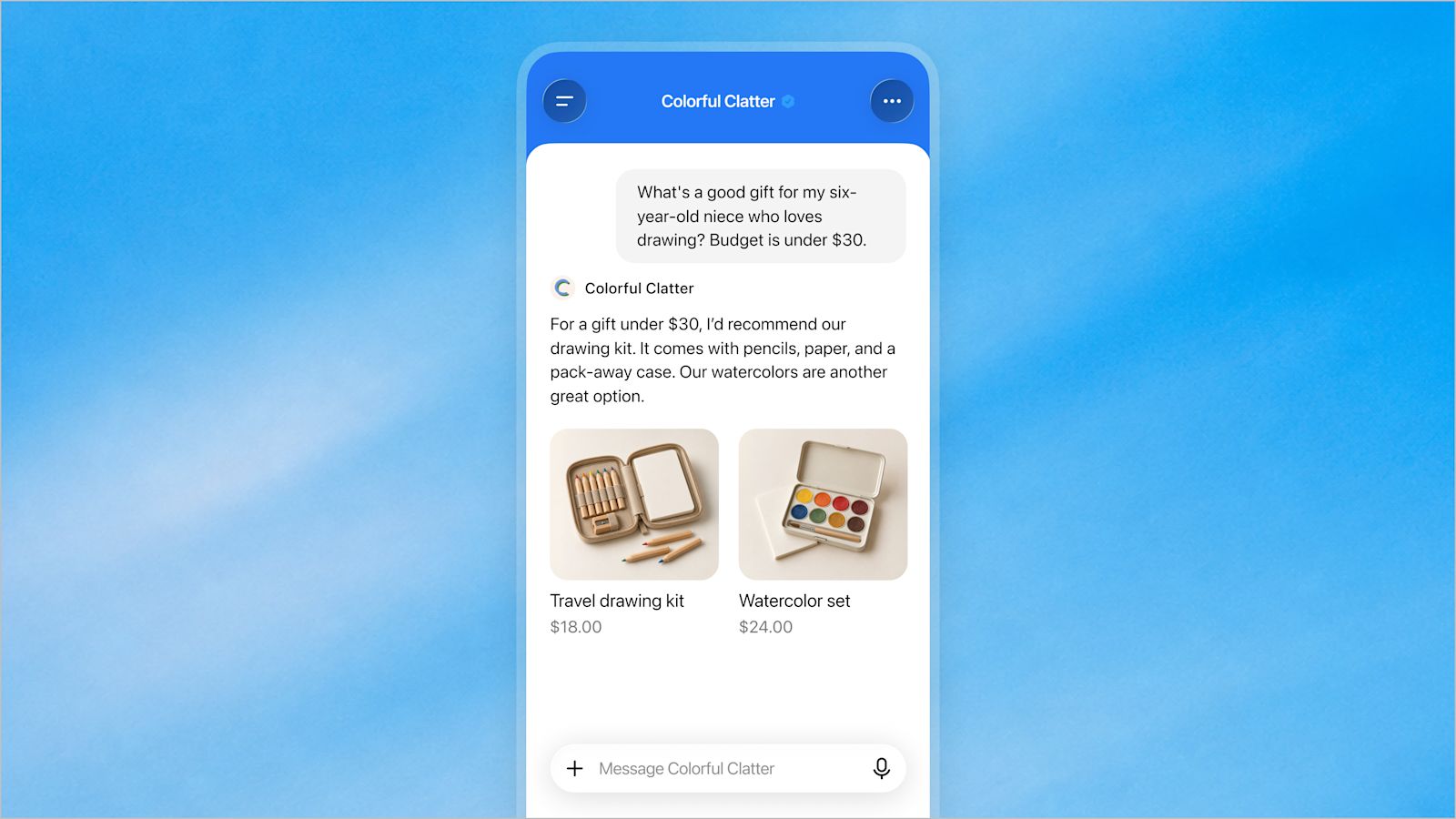
A Business Agent conversation, from OpenAI’s launch example. Image: OpenAI.
There is a commercial angle too. OpenAI already lets businesses sponsor their agent as a ChatGPT Ads destination, so the free agent sits right next to a paid version of the same thing. OpenAI states that advertising doesn’t influence ChatGPT’s independent answers.
If you sell online, the useful preparation is the same either way: a clean, complete product feed, clear delivery and returns policies on your site, and product pages that answer the questions buyers actually ask. If you run on Shopify, much of that is already in place, and our Shopify team can help tidy the catalogue data ChatGPT reads.
What this means for SEO and AI search
When a platform the size of ChatGPT hands every business a mentions-and-clicks dashboard, AI visibility stops being a side project. Expect the question in marketing meetings to shift from “should we care about ChatGPT?” to “why did our number drop this month?”
Three things are worth doing about that:
- Agree on definitions now. Mention, citation, click and visit mean different things in different tools. Settle the terms before the numbers reach a board report.
- Keep your information consistent everywhere. Business Hub is one source among many. ChatGPT still draws on your website, reviews, directories and press coverage, so your name, services and locations need to match across all of them.
- Measure beyond ChatGPT. Your customers also use Google AI Overviews, AI Mode, Gemini and Perplexity. A single dashboard on a single platform is a starting point, not the full picture.
What to do this week
- Claim your business in ChatGPT Business Hub if you run an online business, and complete Persona verification.
- Fill in every profile field, and connect your product feed if you sell products.
- Write down your first week of mentions, clicks and click-through rate as your baseline.
- Test the prompts your customers would use, across ChatGPT and the other AI platforms, to see where you are named but not cited, or not named at all.
If you would like a hand with any of it, from setting up your profile to working out why competitors appear in AI answers and you don’t, our generative engine optimisation team does this work every day. Get in touch and we’ll take a look.
FAQ
Is ChatGPT Business Hub free?
Yes, during the beta. Claiming a profile doesn’t require an ads account or an enterprise agreement. OpenAI hasn’t ruled out paid features later.
Will claiming my business make ChatGPT recommend it more?
No. OpenAI says claiming lets you manage your information but doesn’t guarantee more visibility or control over ChatGPT’s recommendations. Accurate, complete information can help ChatGPT match you to relevant conversations.
Can a Perth business claim a profile?
Online businesses can claim an existing profile or add one now. Local stores and restaurants can currently only claim existing US listings, so physical businesses in Australia will need to wait for a wider rollout.
What counts as a mention in Business Hub?
For an online business, a mention counts only when ChatGPT references your website. Your brand name on its own doesn’t count. For a local business, it counts when ChatGPT shows a result for your location.
Why don’t Business Hub clicks match Google Analytics?
Business Hub counts clicks on links in ChatGPT, not completed visits. Some clicks never load, and some ChatGPT visits arrive without referrer data and show up as direct traffic.
Can I see the questions people asked about my business?
No. You see up to five discovery topics, which are themes across conversations where your site was cited. OpenAI doesn’t share individual prompts or chats.
Can my agency manage the profile for me?
Yes. The admin who claimed the business can grant an agency access in Business Hub. Each person uses their own ChatGPT account.
Sources
- Introducing Businesses in ChatGPT, OpenAI, 10 November 2026
- Setting up your business on ChatGPT, OpenAI Help Center
- OpenAI’s new business agents give brands a free way into the conversation it’s also selling as an ad, Digiday, 10 November 2026
- ChatGPT Business Hub, OtterlyAI, November 2026